Elisabeth, Salomé, Nietzsche, and the Whip
For the Feminist Romp Through the History of Philosophy series, we take a look at the women who shaped Friedrich Nietzsche’s legacy, for better and for worse.
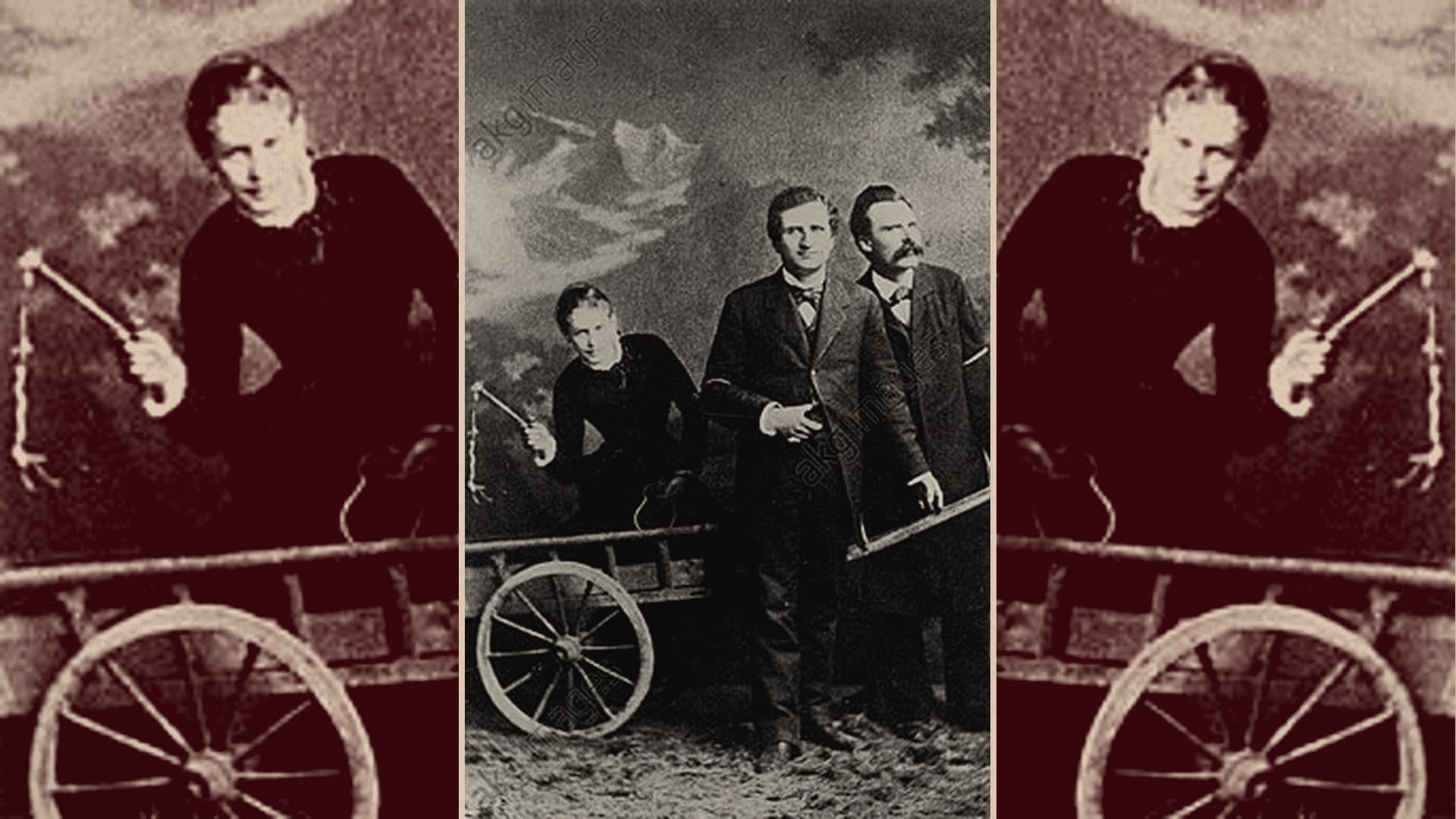
“Supposing truth is a woman - what then?” —Friedrich Nietzsche, Beyond Good and Evil
I didn’t need an algorithm to teach me this, but I have noticed they eventually start serving me animal in peril and rescue content. (It figures out that animal cruelty is an emotional button for me, as with a lot of other people, despite the fact that I never seek out this content.) I became involved with dog rescues where I live in Latin America, after my dog befriended a dog living in an open plaza here. I asked around and was told that he had been abandoned during covid by the man who used to have a business in the plaza. While photographing him to try to find him a home, I discovered he was sick and got him medical care. I took him to the vet, fed him, and loved on him, and he started to look much better. This is when an “owner” showed up to claim that it was his dog. He wrested the dog from me, I took him to the neighborhood court (good system in theory, but corrupt as hell), hired a lawyer since I don’t know my way around the system, and six months later figured out that the interests of the lawyer, the “animal welfare” person who had been involved, and the judge were all aligned against me (and the dog) in a corrupt system built for payola. They were all getting paid and I was doing the paying, so the case lingered as long as they could keep it going. (Even the “owner” probably just wanted me to pay him for the dog, I realized way too late.) It wasn’t until I stopped paying the lawyer that the case was suddenly and finally resolved, and not in my favor. In my heart of hearts, I know they let that dog loose into the streets the moment it was over. They had removed him to the outskirts of the city, inaccessible to me. This is just one story of many I could tell of the horrible treatment of animals in this country where I was born. It’s enough to make a bald, buddhist reflect…
I think about Nietzsche’s unraveling a lot. He collapsed on a street in Turin in January 1889 after throwing his arms around a horse being whipped by his owner, and he was never the same after that breakdown. He spent his last eleven years being cared for by his mother, and then his sister, and never wrote anything more. Ironically, this is when his fame, which had barely begun when he broke down, grew enormously. Most everything people know or think they know about Nietzsche has been shaped by his sister Elisabeth Förster-Nietzsche, who took control of his literary estate; and second, by the spectre of his love-interest Lou Andreas-Salomé (more on her below).
Nietzsche’s opinion of women’s intellectual capacities is plain for all to read on the pages of his works. In Beyond Good and Evil (1886), he writes: “when a woman has scholarly inclinations there is generally something wrong with her sexuality.” Thus Spoke Zarathustra has his most famous line, usually taken without the right context: “are you going to women? Do not forget the whip,” spoken by the character of an old woman to Zarathustra. (Interpreters will argue for the next century whether it represents Nietzsche’s own views or not.) In a bad karmic turn, his sister Elisabeth ends up steering his intellectual legacy - you will see why “bad” soon.
Elisabeth was estranged from her brother when he had his mental breakdown. This was in part because Nietzsche despised her husband Bernhard Förster’s antisemitic nationalism, and he said sharply in letters. When Elisabeth took control of his papers and founded the Nietzsche-Archive, she organized some of his work (notebook fragments, drafts, outlines) into the book which would, for a defining season following his death, define him as an intellectual figure: The Will to Power (1901). As Nietzsche scholars have noted, much of the material had been rejected by Nietzsche himself in a draft he ultimately abandons. But Elisabeth and her collaborators published the cherry-picked fragments from his works as his suppressed, magnum opus, and as the systematic culmination of his thought, defining his intellectual legacy only after his death.
Elisabeth’s The Will to Power was an editorial construction, not a suppressed book containing politically suppressed thoughts. Nonetheless, it became the single most influential “Nietzsche book” for half a century. It shaped, for example, how Heidegger (and actual Nazi) read him. Ironically, it was a woman exercising precisely the kind of systematizing, canon-making scholarly authority Nietzsche himself didn’t think women were capable of, and not in a good sense. Elisabeth spent her last years in the 1930’s cultivating her Nazi identity. She invited Hitler to visit the Nietzsche-Archive, and Hitler did indeed visit more than once — we have the photographs that prove it. She purposefully curated the Archive’s public image to align with the National Socialist ideology, adding cement to the association between Nietzsche and fascism. It took a generation of Nietzsche scholars like Walter Kaufmann, amongst others starting in the 1950s, to unravel these origins.
We know Nietzsche himself broke with musician Richard Wagner, whom he regarded as a mentor and close friend, in part over Wagner’s antisemitism. Nietzsche wrote openly with contempt for the rising German nationalism and their antisemitic rabble. He put himself forward not as a German thinker, but as a European one. None of these facts survived his sister’s campaigns to dis-habilitate him for her cause. And here I think of Socrates and his rejection of writing; how right he was to be suspicious of how an author’s words can be made to represent them in their stead and absence.
The other woman who shaped Nietzsche’s work and legacy is Lou Andreas-Salomé. He fell hard for the brilliant, Russian-born writer when he met her in 1882, proposed marriage to her twice, and was rejected as many times. Things ended badly and painfully, shaping his work the way trauma often does shape our work. Before his death, Salomé published Friedrich Nietzsche in seinen Werken (1894, or “Nietzsche in his works” which was translated simply as Nietzsche), one of the first serious book-length treatments of his philosophy. (He was still alive, but no longer capable of reading or responding to it.) Her work is the origin of the division of his works into three distinct eras: his youthful works where he was a disciple of Schopenhauer and Wagner; his skeptical, positivist middle period; and his more mystical, late period that includes Zarathustra. She identifies main themes that have endured in Nietzsche scholarship: the eternal return, the role of suffering and overcoming, etc.
Where Elisabeth’s Will to Power would present her brother as a systematic architect of doctrine, Salomé showed him as the opposite: restless, contradictory, and unfinished. Salomé went on to study with Freud and became a practicing psychoanalyst, and her book now reads like an early draft of the psychological approach to philosophers. She saw something that the man who doubted women’s minds had told us about himself and then forgot: the thinking cannot be separated from the life. (Elisabeth understood herself to be working against this earlier interpretation —Salomé text came first — and attacked Salomé as a Russian adventuress who had toyed with her brother and broken his heart. She also cast doubt on Salomé’s account of their friendship.) Reportedly, Nietzsche believed Salomé to be the most intelligent person he had ever met, and there are always these exceptions to the rule, no? It was Salomé, with her woman’s mind, that did the deep, rigorous, world-historical work, which he claimed women in general couldn’t do, of breathing life into his work, into posterity.
Feminist philosophers are not in agreement over Nietzsche in particular, but generally over what to do with all this. Reading the essays in Kelly Oliver and Marilyn Pearsall’s edited Feminist Interpretations of Friedrich Nietzsche (1998), a century out from his death, there is a way to read Nietzsche’s philosophy against his own remarks about women. In metaphysics, feminists have resourced his attack on fixed essences and stable substances. In epistemology, and given his remarks about truth being a woman, the very idea of a fixed, stable meaning or essence for “woman” comes into question. This is what Derrida writes about in his excellent Spurs: Nietzsche’s Styles (1978), which turns on Nietzsche’s opening line from Beyond Good and Evil: “Supposing truth is a woman - what then?” Derrida treats this not as an insult, but as an opening. Why would the question of truth and that of woman be tied? It turns out to be a most interesting of involvements with Nietzsche’s philosophy. For another day.
Other feminists argue that Nietzsche’s obvious misogyny cannot be separated from his philosophy in this way: it is interwoven too deeply, his philosophy and his rhetoric of masculine strength and feminized weakness, his contempt for women is clear. I believe it is both: he did have contempt for women, a contempt that is simply the other side of the coin of his passion and adoration for some exceptional women, or one particular woman. But that interpretation of his work and life never closes complete to noose him off from the resources found in his work for feminism and counter-cultural thinking.
The story I have told you above, about him not being a Nazi, maybe that too is a bridge too far into re-habilitation. Walter Kaufmann’s postwar Nietzsche was a rescue operation, making Nietzsche an existentialist humanist, safe for American undergraduates. Later scholars have pushed back: Nietzsche was no friend of the antisemites, but he was no friend of democracy, socialism, feminism, or equality either. He happily accepted Georg Brandes’s characterization of his politics as “aristocratic radicalism.” He wrote about the “blond beast,” about breeding a higher type, and about the many existing to serve the exceptional few. In The Genealogy of Morals, he credits the Jews with the “slave revolt in morality,” and he meant it as a diagnosis, not a compliment.
He held the antisemitic rabble in contempt, but for being rabble. His counter-cultural stance put him against the mass movements of his day, and that same disdain for the herd was there for a later mass movement to quote selectively. Elisabeth did not have to invent the material out of thin air, she just plucked it out from his writings.
In the end, I return to “do not forget the whip” and the whipping of the horse that did him in. I think I understand being so aggrieved over the mistreatment of an innocent animal that you lose your mind. But how is it that turning that same cruelty on women… How is it that men, sometimes the same man, can turn on women? What if: If an essential part of your identity, and the strength you project as a man, is premised on denigrating the feminine, then maybe that is how this misogyny is possible. Being a man does not always mean being cruel to animals; but being a man does necessarily involve accepting cruelty towards women, even if not always at your own hand.