Foucault’s Discipline and Punish, A Primer
A primer on the book that explains why modern power doesn’t need to torture you, it really just needs to watch you.
📣 Announcements
This is your last chance to join How to Become a Philosopher, Or Just Learn To Think Like One, the live 3-hour workshop on reading philosophy for pleasure, starting from your own life experiences and perspectives.
Deets: Saturday, November 14 · 12:00 PM PST / 3:00 PM ET / 9:00 PM CET
You’ll leave with a reading routine you can keep, a method for close reading, an ideas notebook that still works in month three, and (for live participants) a 2-week reading challenge with an accountability pod. Here’s 20% off. Use code A2GD2IO7 at checkout:
- Live: $68 (normally $85). Seats are limited.
- Video only: $52 (normally $65).
“He who is subjected to a field of visibility, and who knows it, assumes responsibility for the constraints of power; he makes them play spontaneously upon himself; he inscribes in himself the power relation in which he simultaneously plays both roles; he becomes the principle of his own subjection.” —Michel Foucault, Discipline and Punish
Michel Foucault published Surveiller et punir in 1975 (translated into English as Discipline and Punish in 1977), and it opens with one of the most notorious first pages in twentieth-century philosophy: a full, gruesome account of the 1757 public execution of Robert-François Damiens, who attempted to assassinate Louis XV. I will spare you the details. Foucault doesn’t quote this for shock value exactly; he quotes it because he wants you to feel the physical revulsion, so you feel how different this form of power is from the one you actually live under. And then, a few pages later, he gives you a prison timetable from eighty years later: wake at six, work, silence, work, meals, work, sleep. No blood anywhere in this routine, no physical force expended. And that is his point.
Foucault’s central claim is not that punishment got more humane between the eighteenth and nineteenth centuries. Where public torture punishes the body (it is meant to restore the sovereign’s wounded authority in front of a crowd, the king’s power made visible through the criminal’s visible pain), the prison doesn’t need to punish the body. It targets the soul, Foucault’s word, used deliberately and a little provocatively. The whole “apparatus” of habits, timetables, drills, and self-monitoring produces what he calls a “docile body,” one that has learned to regulate itself without needing to be watched every second, because it might be watched at any second.
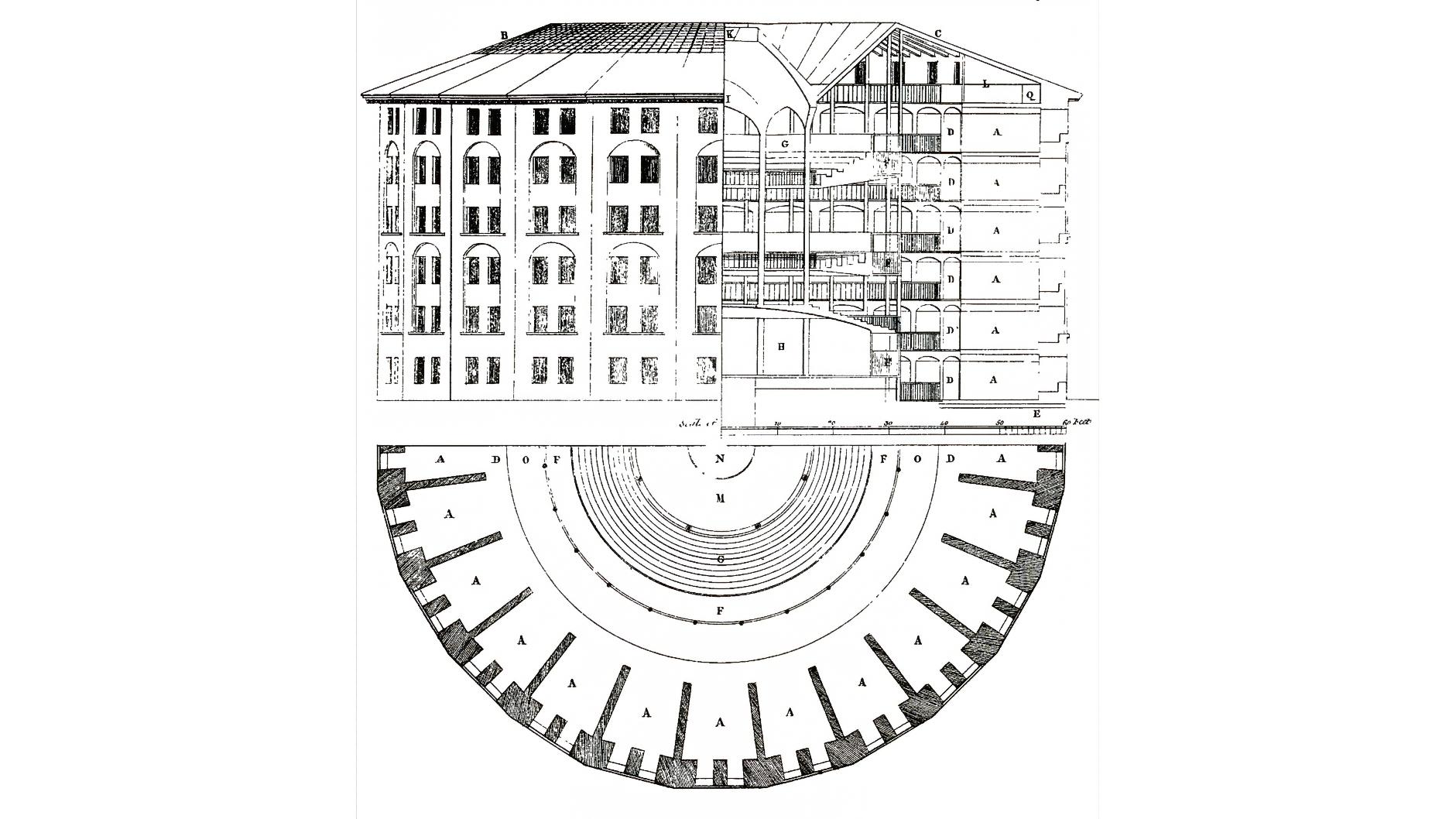
He refers his ideas to Jeremy Bentham’s Panopticon, and it’s the single most-cited idea in the whole book. Bentham designed (but never built) a prison with a central watchtower and a ring of individual cells around it, backlit so that inmates are always visible to the tower but can never see whether anyone is actually inside it watching them. (I find the lighting detail so interesting, especially as compared with the bonfire-lit cave in Plato’s analogy…) The genius of the design, Foucault argues, is that it doesn’t have to watch everyone constantly. Once you can’t tell whether you’re being observed or not, you start behaving as though you always are. That is, you internalize the surveillance. You do the guard’s job for free, permanently, because uncertainty is a more efficient disciplinary tool than certainty. Foucault calls this “panopticism,” which is any arrangement that produces self-monitoring through the mere possibility of being seen. We can deduce from this that a major manifestation of power is the ability to see without being seen, of being surveilled without knowing the whos and hows and whens.
The reason this book keeps being read is that Foucault’s real target was never just prisons. He traces the same disciplinary techniques (timetables, ranking, constant examination, the organization of bodies in space, the normalizing gaze) through the school, the hospital, the barracks, and the factory, all of which emerge as recognizably modern institutions in the same historical window. His argument is that a “disciplinary society” doesn’t rely on one big centralized authority handing down punishment from above. Power, in this account, is a network of relations that runs through everyone, including the people it’s supposedly oppressing, rather than something a king possesses and wields upon his subjects. This makes it more insidious and hard to refuse to participate in. This type of power is diffuse, distributed across thousands of small institutional routines, each one training our bodies to be productive, predictable, and self-correcting. This type of habituation reaches our psyche, our very souls, and our power to imagine otherwise.
What hangs in the balance is Foucault’s larger idea of power/knowledge: the claim that systems of knowledge (medicine, psychiatry, criminology, pedagogy) don’t just describe people, objectively or neutrally. They produce norms, categories of normal and deviant behaviours that then get enforced through exactly the disciplinary techniques described above. The prisoner, the hysteric, the delinquent, the student, the worker, none of these are natural kinds discovered by science. They’re produced by an apparatus that needed to exert micro-corrections.
You do not need to be reading this in a prison studies seminar for the argument to hit close to home. Once you have the concept of how panopticism works, it is very hard to unsee it: the open-plan office where nobody knows who’s actually looking at their screen, now become the BOSS software that tracks your every movement while working — clicks but also eye movements, even facial expressions. The algorithmic feed that changes your behavior because you suspect, without confirmation, that it’s always evaluating you. I once worked in a tech start-up that implemented what they termed “The Game,” which was essentially having everyone quantitatively evaluate their work mates on a bi-weekly basis; what one got to work on and advancement hung on what people thought of you, not necessarily your performance. If you’ve ever been surveilled at work (who hasn’t, at this point?), you know that you can feel eyes on you, and it doesn’t feel good or right. In the case of “The Game” it didn’t stand up to human ingenuity and the results were so nonsensical after just a few months that they had to stop using it.
Foucault wrote this decades before anyone had a smartphone, but he would not have been surprised by the more or less recent technological turns into what Shoshana Zuboff named surveillance capitalism. That would be a great place to go read more. Also, Deleuze’s short 1990 essay “Postscript on the Societies of Control” is worth reading right after this: it picks up exactly here, asking what happens when the enclosed, walled disciplinary institution (the prison, the school building) gives way to a more fluid, continuous, data-driven form of control that doesn’t need walls at all. You can read it with a free account on JSTOR. Finally, you can follow these ideas into Byung-Chul Han’s work in Psychopolitics: Neoliberalism and New Technologies of Power. You will recognize Foucault’s ideas from Discipline and Punish in many places; it is one of the most influential works of 20th Century European Philosophy.
References
Foucault, Michel. Discipline and Punish: The Birth of the Prison. Translated by Alan Sheridan, Vintage Books, 1977 (orig. 1975).
Bentham, Jeremy. Panopticon; or, The Inspection-House. 1791.
Deleuze, Gilles. “Postscript on the Societies of Control.” Translated by Martin Joughin. October, vol. 59, Winter 1992, pp. 3–7.
Han, Byung-Chul. Psychopolitics: Neoliberalism and New Technologies of Power. Verso, 2017.
Zuboff, Shoshana. The Age of Surveillance Capitalism: The Fight for a Human Future at the New Frontier of Power. PublicAffairs, 2019.