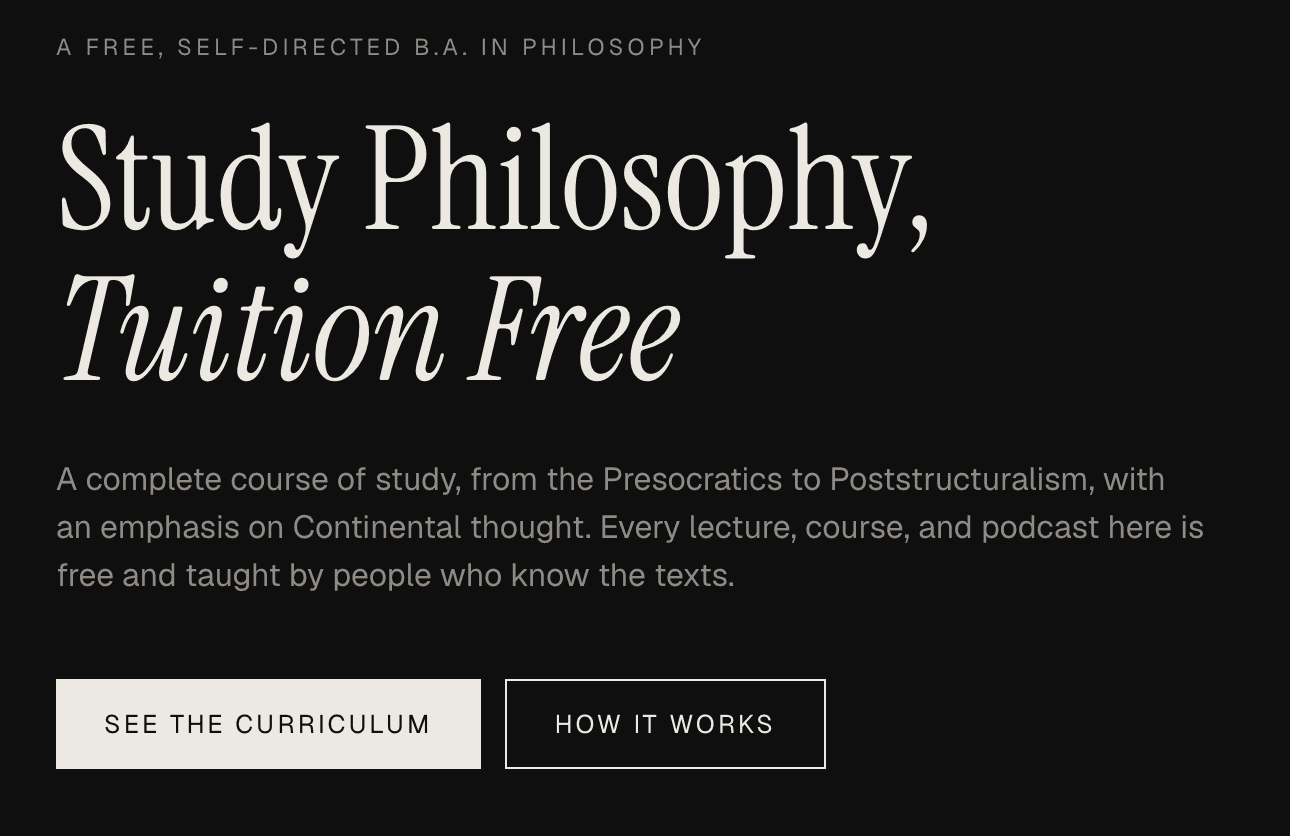
Study Philosophy, Tuition Free
A complete course of study, from the Presocratics to Poststructuralism, using all free resources available on the internet.
Some of the best philosophy teaching ever recorded is sitting online for free. Hubert Dreyfus’s Berkeley seminars on Being and Time. John Caputo’s lectures on Derrida and Levinas. Deleuze’s own seminars at Paris 8. J.M. Bernstein on Hegel’s Phenomenology of Spirit. Peter Adamson’s history of philosophy “without any gaps.”
The problem isn’t just access, it’s where and how to dive in. What do you read first, and what can you skip? Which of the thousands of lectures on YouTube are worth forty hours of your life? I started curating this resource list in 2008, and then I created a map for independent study in philosophy.
Philosophy for Independent Scholars is a free, self-directed path to the equivalent of a B.A. in philosophy, with an emphasis on Continental thought. It runs from the Presocratics to Poststructuralism, and every resource on it is free and freely available on the internet.
What’s in It
The curriculum has 106 resources in eleven sections:
- Start Here: how to read philosophy and theory, a fast tour of the whole history, and some basic logic
- Ancient Philosophy
- Medieval Philosophy, including philosophy in the Islamic world and Jewish philosophy
- Modern Philosophy, from Descartes through Kant, Hegel, Kierkegaard, Marx, and Nietzsche
- Phenomenology & Existentialism: Husserl, Heidegger, Merleau-Ponty, Arendt, Sartre, Beauvoir, and Fanon
- French Theory: structuralism, Derrida, Levinas, Foucault, Deleuze, and Lacan
- Critical Theory & Decolonial Thought: the Frankfurt School, Benjamin, psychoanalysis, and Africana philosophy
- Feminist Philosophy: Beauvoir, Irigaray, Young, Haraway, Butler, Fraser, Ahmed, and Braidotti
- Electives and Interdisciplinary Electives
- Capstone: write and share a philosophical essay of your own
Most entries also link to free readings, 189 in all: public-domain primary texts, open-access articles, and Stanford Encyclopedia of Philosophy entries, so you can read alongside the lectures.
How It Works
You don’t have to do everything. As in an undergraduate major, you choose. Start with Start Here. Then take at least two courses each in ancient or medieval, modern, and contemporary philosophy, plus two-four electives, and finish with the capstone.
Each section marks its core resources, the strongest choices, and you can switch the curriculum to show only those. If you want the shortest serious path through, that’s it.
Sample Paths
To show how the choosing works, the Sample Paths follow four imagined students through the curriculum, each building a full course of study around one interest. Nadia Brooks, a 34-year-old labor and delivery nurse in Oakland, wants to know whether the underpaid care work that keeps her ward running is an injustice, and who is responsible for it. She starts by writing a Statement of Intent, then follows feminist philosophy back to its sources: Plato and Aristotle on women for her ancient requirement, Hegel (because Beauvoir builds on him) and Marx on labor for modern, and most of her time in the contemporary sections with Beauvoir, Young, Fraser, Ahmed, and Butler. Every choice comes with the reason she made it, and her capstone essay draws on Young and Fraser and on her years at the bedside. At six hours a week, mostly lectures on her drive to and from the hospital, she gives herself until next summer.
Build Your Own Path
When you’re ready, My Path lets you put together your own. Pick courses from a checklist of the curriculum, or start from one of the sample paths and change it to suit you. The planner checks your choices against the requirements, adds up the hours, and lets you mark off each course as you finish. Your path is saved only in your browser and nothing is sent anywhere. You can print it, or copy a share link to send to a friend or open on another device.
Mentoring
The curriculum is built for study on your own, but philosophy has always been done in dialogue. Mentoring is available on request, one-on-one or for a reading group you organize yourself. One-on-one, you can talk through a text or a problem you’re stuck on, get feedback on an essay (including your capstone), or plan a course of study that fits your interests and your time. Groups can bring in a mentor to open a new text, to check in when the reading gets hard, or to close a section with a discussion of what you’ve read or of each other’s essays. You set the agenda and the pace: send a request saying what you’re working on and what kind of help you want, and the mentor replies with availability and terms. Nothing is scheduled or owed until you both agree.
Why I Made This
I’ve been building public philosophy infrastructure for a long time. In 2006 I started thinkPhilosophy, which ran philosophy salons in San Francisco and one of the first philosophy podcasts. A couple years later, I started building an early version of this curriculum. Back then there was very little good free material on 19th- and 20th-century Continental philosophy, and some of what existed has since disappeared. (For example, Caputo’s lectures survive only in the Internet Archive’s Wayback Machine.)
A lot has changed. There is now more good, free philosophy online than anyone could get through, and that makes the curation matter more, not less.
Philosophy belongs to everyone. It shouldn’t depend on tuition, admissions, or living near a university.
Philosophy for Independent Scholars is a Philosophy Publics production. The curriculum is licensed under CC BY-NC-SA 4.0. All linked lectures and texts belong to their creators.